Hello!
Welcome, and I'm so glad you're here. My name is Dave. As a kid growing up in the 1970s and early 1980s, my dad and I were always fascinated with electronics. I was fortunate enough that my dad could afford to buy me one of the very first personal computers when they came out around 1980. I remember sitting in my bedroom tinkering with writing simple programs. Later I got into electronics, playing around with and/or gates, LEDs and bread boards. By today's standards, and even back then, it was extremely simple. But I loved it.
But I also learned that I wasn't ambitious enough to become an electrical engineer. At the same time I fell in love with writing, editing and publishing. Stints on the high school and college paper were followed by my first "real" jobs, first on a community newspaper, and then as an editorial assistant at a trade magazine. I'm no longer an editorial assistant, but I've worked in what's now called business-to-business publishing ever since, watching an entire industry transform itself from print to digital.
I still remember my excitement when the Internet broke out of the confines of its origins in the scientific community, and when the World Wide Web was literally invented by a single person. It fused two passions of mine -- writing and computers.
In those heady early days, e-mail, which we now think of as a chore at best, was amazing! Compared to finding a paper and pen, writing out a letter long hand, finding an envelope, finding a stamp, assembling and addressing it all by hand, and dropping it in a mailbox, e-mail was revolutionary.
Whether it's glowing on the screen or typeset and baked onto paper, I've never stopped being fascinated with words, their meaning, and how they are represented visually.
Then, the rise of social media happened.
I will confess I never understood (and still don't understand) the appeal. Weak ties to many people never made sense to me. I prefer strong ties to a few people. But clearly the inventors of social media totally discovered how ludicrously profitable it could be to build ecosystems that hijack our attention, distract us at best, and get us all enraged (or feeling badly about ourselves) at worst.
The discovery that we can hijack the limbic brain with what Brené Brown brilliantly called “shitty algorithms that steal our attention” led to a handful of people making billions and billions of people feeling badly about themselves, or turning to self-harm.
The Center for Humane Technology has done a lot of great work documenting the negative effects of social media (and have now focused their attention on the threat from uncontrolled AI).
Beyond the ills of social media, just keeping up with the flood of text messages and email accounts is a constant battle that few of us are winning.
Did you know that it didn't have to be this way?
What if we could go back in time, and re-invent what it means to communicate electronically? How would we do it? How would it work?
That's what started me on this journey. By now anyone who has a Kindle or e-reader is familiar with electronic ink (e-ink). The appeal to me is visceral - it has the high contrast and resolution of paper (black text on white screen), yet it can be controlled electronically. Even better, whatever's on the screen stays on the screen, even when the power is off. Like a magazine article or a web page, it's a blank canvas. But it carries none of the baggage of print, and I thought maybe we could give electronic communications a do-over.
Let's get personal
I'm married with three beautiful daughters, all launched and out of the house and in their 20s. One daughter has special needs and lives in a fantastic facility in the Chicago area that provides round-the-clock care and attention. We're there often, and she visits home often.
Our other two daughters moved out over the last three years and have launched their own lives. They're learning to balance career, friendships and relationships. Every parent knows the feeling of walking that fine line between telling them what to do (or not to do) or letting them figure it out for themselves as their journey unfolds.
It's been a joy to watch my girls become young women with thoughts, feelings, and opinions (even if we disagree on some things). I delight when they make good choices (which I chalk up to my wife doing the better job of parenting) and I agonize when they are contemplating making not-so-good choices, or deferring taking a needed action. I'm not unique--that's everyone who's ever had a child--possibly even you.
So often I have found myself wishing I could find some new method of leaving a heartfelt message for my kids in a way that persists and that can't be easily ignored or dismissed. Texts are great for real-time communication and what family doesn't have a text thread going. But for a topic that's important or sensitive, text messaging (or e-mail) doesn't seem right.
True, writing letters is still a thing, but for whatever reason that doesn't seem appropriate when I want to just send a one-liner that re-assures or builds confidence, reinforces our unconditional love, or, admittedly, gently prods them to take action on something they've been hedging on
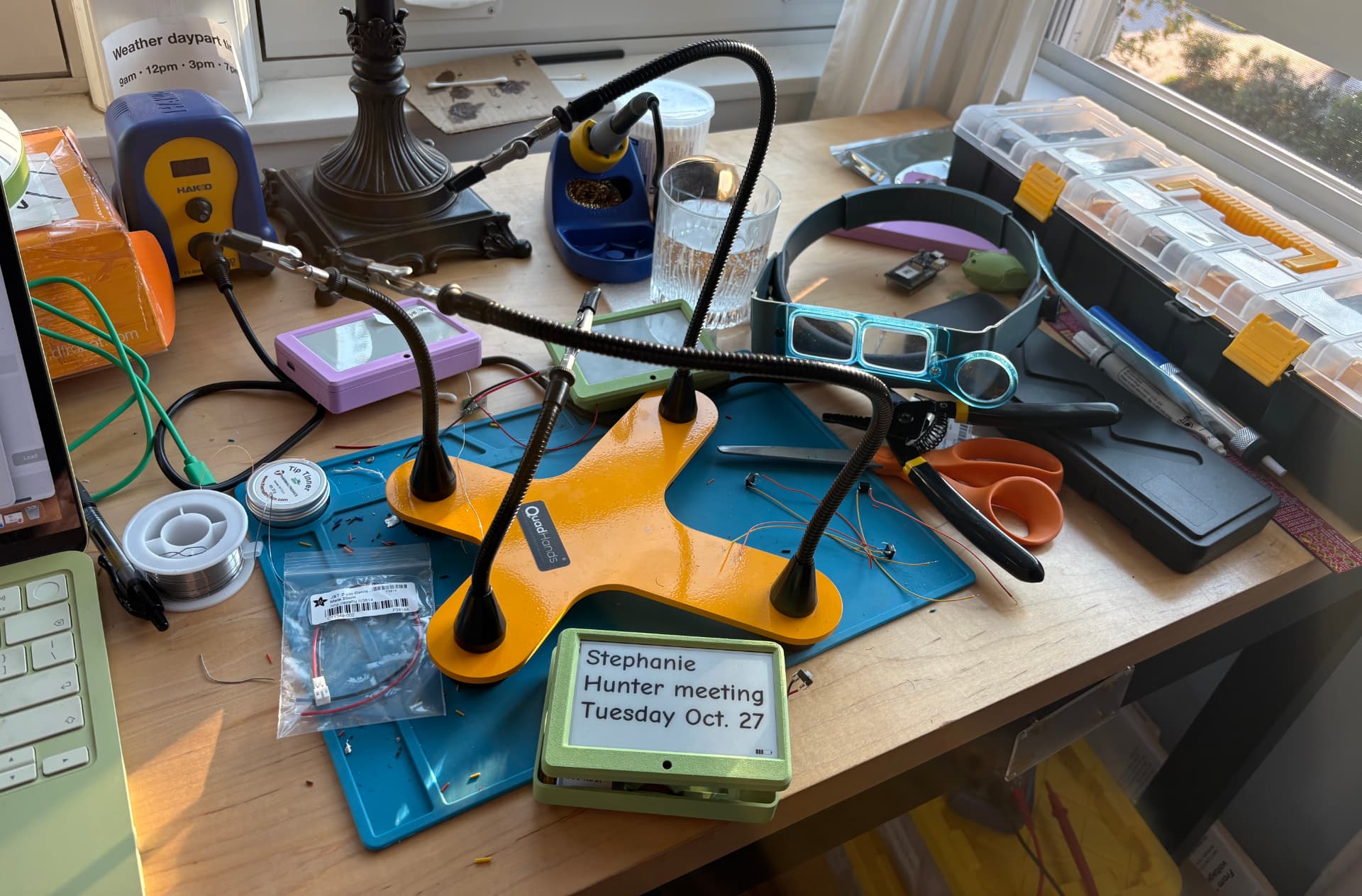
Thus the original Maggie e-ink refrigerator magnet was born. (Or more accurately, is in the shop, being born as you read this.) Maggie is designed to connect geographically separated households. While you can send electronic sticky note reminders to your family and see current weather, that's not the main thing. Indeed, there are many e-ink "organizer" products designed to organize your family's schedule.
What Maggie is really about is a way to draw you closer to your kids, friends or family or anyone you want to send little electronic sticky notes to whenever you want.
If you have parents who are starting to get along in years and live alone, and are worried about them being isolated, imagine them seeing a note from you or any of the grandkids when they wake up to brew their morning coffee. And imagine them leaving a note for you, reminding you of how proud they are of what you've accomplished, or letting you know how they're feeling.
With the companion app that runs on your smartphone, you or anyone in your group can tap a quick message and hit send, and within an hour it's showing in rotation on everyone's fridge, whether they live across the street, across town or across the country. I'm so excited about this way of communicating that I've been "sending" messages to my family via the app (to prototype virtual units) for months while I build out the software and hardware. I can't wait for the real prototype units to roll off the assembly line (my desk).
For anybody who’s ever felt bad about themselves doom-scrolling through social media (or seen their kids suffer from social media), Maggie represents a turn that we could have taken in a different direction. And you know what? It's not too late.
With Maggie we can make the people we love feel better about themselves, while giving families their own private surface for durable, persistent messages. The hardware costs about as much as taking your family out for a good dinner and the monthly fee to keep everyone connected is less than the price of a single streaming service.
One more thing
Since I was ambitiously trying to reinvent electronic communications, I wanted to be careful not to add any burden to anyone who becomes a Maggie family.
In the Maggie ecosystem every decision we made puts your attention, time and sanity first:
- There are no notifications to check or dismiss.
- There are no inboxes to clear.
- No dialogs to dismiss.
- There are no blinking lights compelling you to check messages.
- There are no ads to scroll past.
- It is not possible to "doom scroll". In fact, there is no scrolling of any kind.
- Nobody will be able to upload pictures of their fabulous vacation or above-average children. In fact, no pictures of any kind.
- If there are multiple messages in your queue, you can't even advance to see the next one. When you glance at your Maggie unit later in the day, you'll see it. :)
- No large corporation is using your data against you.
- You don't have to remember to plug in Maggie every night. She's designed to run for two to three weeks on a single charge.
Nothing will ever appear on your Maggie unit that will make you feel bad (unless someone in your family intends for that, and let's hope not!). In fact, we intend for the opposite to be true, that everything that appears on your Maggie unit either makes you smile, or lets you know that someone close to you is thinking intentionally about you. Our starting principle was always, how can we use digital communications to spark joy in little moments throughout the day. Everything sprang from that.
Maggie is designed around your family's privacy. Nobody outside your group can read your messages, and nobody can post to your family's Maggie units without you explicitly authorizing them to do so. There is no microphone that is constantly listening to you. You can't talk to your Maggie unit. If you do, she will not answer.
As the world speeds up, we are longing for ways to slow it down. As more and more messages overcrowd our phones and inboxes, the infinite scroll of our devices creates a perpetual burden. Maggie is not about speed, Maggie is about persistent display of important or thoughtful messages.
We need a surface that’s calm and persistent and filled not with ads or inflammatory messaging but notes from loved ones and friends. That's a small way for us to begin to reclaim what the Internet was supposed to be good for in those early days--connecting with people you care about over vest distances, whether across town or across the world.
— Dave